Saltburn Golf Club Solar — Part 2
Part two covers the completion and commissioning of the Saltburn Golf Club commercial solar installation, including monitoring setup and the projected energy savings and return on investment for the club.
Full Installation Walkthrough
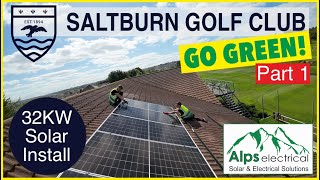
Part two of the Saltburn Golf Club commercial solar installation covers the completion of the electrical work, system commissioning and the projected financial impact of this 31.6KW installation. With all 56 panels installed on the clubhouse roof during phase one, this second phase focused on bringing the system online and verifying that every component was operating at peak performance.
The Solis 30KW three-phase inverter was mounted in the plant room on a dedicated backboard that provides clearance for air circulation around the unit. Commercial inverters generate more heat than residential models due to the higher power throughput, and adequate ventilation is essential for maintaining optimal conversion efficiency and ensuring the longevity of the electronic components. We positioned the inverter on an external wall with ventilation louvres nearby to provide natural airflow.
The DC cabling from the roof arrays was connected to the inverter through DC isolators that allow each string to be individually disconnected for maintenance or fault investigation. The 56 panels were configured across multiple MPPT inputs on the inverter to account for the different roof orientations and tilt angles of the flat and pitched roof sections. Each string was tested individually before being connected, verifying open circuit voltage, short circuit current and insulation resistance to confirm that every panel and connection was performing correctly.
On the AC side, the inverter output was connected to the golf club's three-phase distribution board through a dedicated triple-pole MCB. The three-phase connection means that the solar generation is distributed evenly across all three phases of the supply, which is important for maintaining balanced loading on the electrical infrastructure and avoiding potential issues with the DNO supply.
The commercial G99 application for this installation had been submitted and approved during the planning phase, as the 31.6KW capacity is well above the 3.68KW per phase threshold that triggers the need for DNO approval. Northern Powergrid had assessed the local network and confirmed that it could accommodate the additional generation without requiring any reinforcement works, which is a positive indication of the network capacity in the Saltburn area.
Monitoring was set up through the Solis Cloud platform, which provides the golf club management team with real-time visibility of solar generation, grid import and export, and system performance metrics. The monitoring dashboard was configured to send email alerts if the system output drops below expected levels, enabling rapid identification of any issues that might affect generation performance.
We also installed a large display screen in the clubhouse reception area that shows live solar generation data and cumulative environmental impact figures including tonnes of CO2 avoided and equivalent trees planted. This public-facing display serves a dual purpose: it demonstrates the clubs commitment to sustainability to members and visitors, and it provides a talking point that raises awareness of solar energy in the local community.
The commissioning process for a commercial system is more extensive than for residential installations. We carried out a complete set of electrical tests including earth electrode resistance measurement, prospective fault current verification at every distribution point, and functional testing of all protective devices. The results were documented in a comprehensive commissioning report that forms part of the building's electrical installation records.
Financial projections for the system show an estimated annual generation of approximately 27,000kWh, based on the Saltburn location, the mixed roof orientations and typical North East irradiance data. At the club's commercial electricity rate, this generation translates to annual savings of several thousand pounds on their electricity bills. The Capital Allowance benefit further improves the financial case by allowing the club to offset the system cost against their corporation tax liability.
The payback period for this commercial installation was projected at approximately five to six years, after which the golf club will benefit from decades of free solar electricity generation. The panels carry a twenty-five year performance warranty, the inverter has a ten-year warranty, and the entire installation is covered by the ALPS Electrical workmanship guarantee and MCS certification.
The Saltburn Golf Club project is a flagship example of how commercial organisations in the North East can make a meaningful financial and environmental impact through solar energy. We have been proud to see the system performing at or above projected levels since commissioning, and the club management team has reported significant reductions in their quarterly electricity costs. If you manage a business, sports facility, farm or public building and would like to explore what commercial solar could do for your organisation, we offer free site surveys and detailed financial proposals.
Project Specifications
| Category | Commercial |
| Location | Saltburn-by-the-Sea |
| Specs | Completion and commissioning |
| Duration | 11:50 |
Equipment Used
Solis
Commercial Monitoring Setup
Full System
Commissioning and MCS Certification
Video Chapters
Want a Similar System?
Get a free, no-obligation quote for a bespoke installation tailored to your property.
Get a Free QuoteOr call 01642 790 489



Interested in This Type of Installation?
Fill in the form and our team will get back to you within 24 hours with a free, no-obligation quote tailored to your property and energy needs.